What is a Normal PSA Level by Age?





Article Summary
- The PSA test is a valuable biomarker for the detection of prostate cancer.
- However, a number of factors can cause a rise in PSA, including an enlarged prostate, prostatitis and urinary tract infections.
- While the test has its benefits, it’s also important to remember that it is not always a reliable indicator and should be followed by other tests.
When it comes to prostate cancer screening and raising awareness, PSA testing has an important role.
A raised PSA level can be a sign of a problem, and a PSA blood test can help diagnose that problem.
An elevated PSA level is not the cause of these prostate conditions, but only an indicator of the underlying disease.
Other factors such as age, prostatitis, and BPH have been shown to elevate PSA levels.
However, a low PSA level is a good indicator of a healthy prostate.
In this article, we will be discussing what causes PSA to spike, what you can do to naturally lower PSA levels, and whether there is really such a thing as a ‘normal’ PSA level for men.
What is a PSA Test?
PSA is a protease, which is a group of enzymes that break down proteins into smaller peptides or amino acids.
It is released by the prostate gland, promoting the movement of sperm. However, a small amount escapes into the bloodstream and can be used to monitor prostate activity.
The measurement of serum PSA is commonly used for the early detection of prostate cancer and monitoring of treatment response.
Healthy men have low levels of serum PSA, but they are often elevated in the presence of prostate disorders, including an increased risk of prostate cancer.
If your prostate biopsy was negative for prostate cancer, a PSA test can determine if there is a need for a repeat biopsy.
However, serum PSA lacks clinical specificity as it can be elevated by noncancerous conditions.
The methods implemented most often include:
-
- PSA velocity measures the extent of change in serum PSA over time. An increase of 0.75 ng/ml/y or more can associate with the presence of prostate cancer (Carter et al., 1992). Unfortunately, this approach is limited by time and multiple measurements.
-
- PSA density measures PSA levels relative to the prostate volume. Studies show PSA density values greater than 0.10 strongly associate with prostate cancer (Nordström et al., 2018). However, reproducible calculation of prostate volume is a concern and may reduce the usefulness of this method.
-
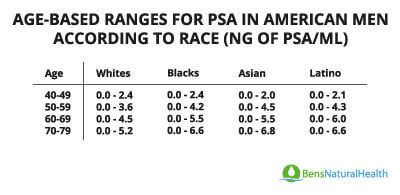
- Age-Specific PSA normal ranges use different age-specific cut-offs to interpret the results of PSA tests. However, negative biopsies can still occur even after adjusting for age, especially in men over 70 years of age (Catalona et al., 2000).
-
- Percentage of free total PSA measures the ratio of the different forms of PSA.
What Does a High PSA Mean?
PSA levels can be affected by several factors, and a rise in PSA may indicate:
-
- prostate inflammation
-
- urinary infection
-
- prostate cancer
-
- recent ejaculation
Alone, PSA levels are not good measures of prostate health so your medical team will need to assess other risk factors.
They may also perform a DRE (digital rectal exam) and/or a multiparametric MRI in order to make an accurate diagnosis.
PSA is not a unique indicator of prostate cancer because PSA screenings can be confounded by other prostate conditions.
For instance, age does not only increase prostate cancer risk but can also increase risk of BPH and urinary tract infection. Thus, patients may present with prostate cancer, BPH, and prostatitis simultaneously.
Both prostate cancer and BPH elevate PSA levels, while prostatitis and trauma may cause fluctuating PSA levels.
Often, levels of PSA gradually return to normal levels with immediate treatment of noncancerous prostate conditions.
Causes of High PSA Levels
Here are 8 things that can cause a high PSA level.
Age
PSA levels may increase with age and potentially with age-associated BPH.
BPH
An enlarged prostate, which is common in older men, can increase the levels of total PSA due to the effect of BPH on the bladder.
UTI
Urinary tract infections may elevate your PSA levels.
Prostatitis
Men under the age of 50 often develop prostatitis. Prostatitis-associated inflammation and prostate irritation can increase PSA levels.
Recent Ejaculation
Some men experience elevated PSA levels after ejaculation. This may persist for 24 hours.
Prostate Injury and Surgical Procedures
An injury to the groin caused by an accident or surgical procedure may spike PSA levels. You should inform your doctor if you had a recent fall, impact or accident.
Prostate Cancer
Prostate cancer often elevates your PSA levels, especially hormone-dependent prostate cancer. However, digital rectal examination and prostate biopsy are required to make a diagnosis of prostate cancer. High PSA level likely links with prostate cancer if you have multiple known risk factors of prostate cancer.
Parathyroid Hormone
This is a hormone that regulates calcium levels and may raise PSA levels because parathyroid hormone can promote prostate cancer growth.
What Are Normal PSA Levels By Age?
The definition of physiological PSA levels remains an active debate. 2.5 ng/mL is safe. 2.6 to 4 ng/mL is safe in most men, but talk with your doctor about other risk factors. 4.0 to 10.0 ng/mL is suspicious. Although this is not always the case.
Men with high PSAs do not always have prostate cancer, while men with very low PSAs sometimes DO have prostate cancer. The prostate gland increases in size and produces more PSA as you get older.
If your PSA test result is high for your age or persistently increasing, your doctor may recommend a prostate biopsy.
Your healthcare provider should consider conditions that can elevate PSA levels before recommending a prostate biopsy.
How to Naturally Lower Your PSA Level
Though you cannot control all of the risk factors of the discussed prostate conditions, lifestyle changes are still the most effective way to maintain a healthy prostate and naturally lower PSA levels.
This includes regular physical activity, a healthy diet, and natural supplements (including vitamin d and omega-3 fatty acid supplements). All of these may help improve your prostate health and can help you maintain an overall well-being. Further, you can make positive choices to avoid the eventual radical prostate cancer treatment, such as radical prostatectomy.
Regular Physical Activity
Regular physical activity can help you maintain a healthy prostate and reduce the risk of prostate conditions.
Several lines of evidence suggest that regular exercise may reduce PSA levels in men. Weight gain links to the development of BPH, prostate cancer, and prostate inflammation.
Weight gain also increases the levels of estrogen, which links to poor prostate health (Prezioso et al., 2007).
Healthy Diet
In addition to physical activity, lower daily calorie intake may help to reduce PSA levels. A low-fat diet that’s rich in fruit and vegetables has been linked to a healthy prostate.
Consume More Plant-Based Antioxidants
Tomatoes
Inflammation and oxidative stress play a central role in the development of several prostate conditions. Interestingly, tomatoes cooked in oil release lycopene a potent antioxidant.
Pomegranate
Pomegranate juice/extract has proven useful in reducing the risk of several prostate conditions through its antioxidant compounds. A phase II clinical trial involving patients with rising PSA showed 8 oz of oral pomegranate juice significantly reduced PSA levels (Pantuck et al., 2005). This positive effect is also replicated when pomegranate extract is used in multicomponent food supplements (Paller et al., 2017).
A randomized clinical trial of a polyphenol-rich multicomponent food supplement that included a 31.25% pomegranate extract found a significant slowing of PSA increase in the food supplement arm vs placebo in men on active surveillance and those experiencing biochemical recurrence (BCR).
Consider Taking a Prostate Health Supplement
It may be challenging to get all your nutritional requirements from dietary sources. If that is the case, you should talk to your doctor about using a .

Worried About Your PSA Levels?
If you want to learn how to naturally lower PSA levels, to speak with one of our expert advisors. This fifteen-minute consultation gives you the opportunity to ask questions and receive tailored advice.
This article is for informational purposes only and does not serve as medical advice. The details provided here are not a replacement for, and should never be depended upon as, professional medical advice. Always consult your physician regarding the potential risks and benefits of any treatment.
Dr. Howard Tay
MD, FACS, Board-Certified Urologist
Dr. Howard Tay, MD, FACS, is a board-certified urologist in Arizona with 25+ years of experience, recognized as a “Top Doc” by Phoenix Magazine.
Our Medical Review Process
At Ben’s Natural Health, we are committed to maintaining the highest standards of accuracy, transparency, and scientific integrity. Every piece of content is carefully developed by medical professionals and undergoes a thorough review every 12 to 24 months. This ensures that our information remains current, reliable, and rooted in credible, evidence-based research. We reference only peer-reviewed studies from reputable medical journals, providing full citations and direct links to enhance trust and confidence. Learn more about our medical review process and research standards.
Our Editorial Guidelines
For over 25 years, Ben’s Natural Health has been a trusted source of scientifically backed, reliable health information. Our editorial guidelines uphold the highest quality and integrity for every article we publish. Each piece is written by qualified experts and undergoes independent quality checks. We prioritize transparency by clearly displaying contributor credentials and biographies at the beginning of every article. Read more about our editorial standards.
Medical Disclaimer
The content on this blog is for informational purposes only and should not be considered a substitute for professional medical advice, diagnosis, or treatment. While our articles are authored and reviewed by licensed medical professionals, they may not address your specific health concerns. Always consult a qualified healthcare provider before making any medical decisions.
Article Sources
- Berquin, I.M., Min, Y., Wu, R., Wu, J., Perry, D., Cline, J.M., Thomas, M.J., Thornburg, T., Kulik, G., Smith, A., 2007. Modulation of prostate cancer genetic risk by omega-3 and omega-6 fatty acids. The Journal of clinical investigation 117, 1866–1875.
- Carter, H.B., Albertsen, P.C., Barry, M.J., Etzioni, R., Freedland, S.J., Greene, K.L., Holmberg, L., Kantoff, P., Konety, B.R., Murad, M.H., 2013. Early detection of prostate cancer: AUA Guideline. The Journal of urology 190, 419–426.
- Carter, H.B., Pearson, J.D., Metter, E.J., Brant, L.J., Chan, D.W., Andres, R., Fozard, J.L., Walsh, P.C., 1992. Longitudinal evaluation of prostate-specific antigen levels in men with and without prostate disease. Jama 267, 2215–2220.
- Catalona, W.J., Southwick, P.C., Slawin, K.M., Partin, A.W., Brawer, M.K., Flanigan, R.C., Patel, A., Richie, J.P., Walsh, P.C., Scardino, P.T., 2000. Comparison of percent free PSA, PSA density, and age-specific PSA cutoffs for prostate cancer detection and staging. Urology 56, 255–260.
- Edinger, M., Koff, W., 2006. Effect of the consumption of tomato paste on plasma prostate-specific antigen levels in patients with benign prostate hyperplasia. Brazilian journal of medical and biological research 39, 1115–1119.
- Gann, P.H., Ma, J., Catalona, W.J., Stampfer, M.J., 2002. Strategies combining total and percent free prostate specific antigen for detecting prostate cancer: a prospective evaluation. The Journal of urology 167, 2427–2434.
- Giovannucci, E., 2002. A review of epidemiologic studies of tomatoes, lycopene, and prostate cancer. Experimental biology and medicine 227, 852–859.
- Nordström, T., Akre, O., Aly, M., Grönberg, H., Eklund, M., 2018. Prostate-specific antigen (PSA) density in the diagnostic algorithm of prostate cancer. Prostate cancer and prostatic diseases 21, 57.
- Oesterling, J.E., Jacobsen, S.J., Cooner, W.H., 1995. The Use of Age-Specific Reference Ranges for Serum Prostate Specific Anitgen in Men 60 years Old or Older. The Journal of urology 153, 1160–1163.
- Paller, C.J., Pantuck, A., Carducci, M.A., 2017. A review of pomegranate in prostate cancer. Prostate cancer and prostatic diseases 20, 265.
- Pantuck, A.J., Leppert, J.T., Zomorodian, N., Seeram, N., Seiler, D., Liker, H., Wang, H., Elashoff, R., Heber, D., Belldegrun, A.S., 2005. 831: Phase II Study of Pomegranate Juice for Men with Rising PSA following Surgery or Radiation for Prostate Cancer. The Journal of Urology.
- Posadzki, P., Lee, M.S., Onakpoya, I., Lee, H.W., Ko, B.S., Ernst, E., 2013. Dietary supplements and prostate cancer: a systematic review of double-blind, placebo-controlled randomised clinical trials. Maturitas 75, 125–130.
- Prezioso, D., Denis, L.J., Klocker, H., Sciarra, A., Reis, M., Naber, K., Lobel, B., Pacik, D., Griffiths, K., 2007. Estrogens and aspects of prostate disease. International journal of urology 14, 1–16.
- Richardson, T.D., Oesterling, J.E., 1997. Age-specific reference ranges for serum prostate-specific antigen. Urologic Clinics 24, 339–351.
- Schwarz, S., Obermuller-Jevic, U.C., Hellmis, E., Koch, W., Jacobi, G., Biesalski, H.-K., 2008. Lycopene inhibits disease progression in patients with benign prostate hyperplasia. The Journal of nutrition 138, 49–53.
Article Update History
Reviewer:
Created on September 20, 2019
Explore More

Should You Poop Before A Prostate Exam?
The prostate gland is located below the bladder and in front of the rectum, producing fluid that makes up part of the semen. Below ...